Nianing, Senegal: the shell-shaped church, the griots' sacred baobab and the nursery
By Demba Sene · Published · 6 min read
Along the road that runs along the Petite Côte, a few kilometers south of Mbour, many travelers pass by Nianing, Senegal without stopping. What a shame. This peaceful village hides three treasures you wouldn't expect to find so close to the hotels: an award-winning church, a baobab steeped in history, and a nursery where nuns care for the little ones. And to discover them, there's a perfect way: a horse-drawn carriage. Here's everything you need to know before visiting Nianing.
Discovering Nianing, Senegal, by Horse-Drawn Carriage
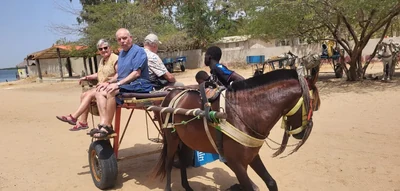
In Nianing, you leave the car behind and hop into a horse-drawn carriage. The pace changes immediately. You move slowly along the sandy tracks, cross the village, children wave, women return from the market. No one is in a hurry, and neither are you.
The carriage isn't just a tourist prop: it's still a daily mode of transport in many Senegalese villages. By taking it, you see the Petite Côte as those who live there do.
A Shell-Shaped Church
First surprise: around a bend in a track, a huge white shell seems to be resting on the sand. This is the Church of the Epiphany of the Lord, one of the most astonishing buildings in Senegal.
A recent history
The first stone was laid in December 2014 by Cardinal Théodore Adrien Sarr, and the church was inaugurated in February 2018 by the Archbishop of Dakar, Mgr Benjamin Ndiaye. It was designed by architect Nicolas Vernoux-Thélot and largely financed by a French benefactor, along with other partners.
A giant seashell
Its shape is inspired by the spiral of the cymbium, the large seashell found on the beaches of the Senegalese coast. Six vaults spiral into each other and rise up to the bell tower, the highest point. Inside, it can accommodate 800 people.
No air conditioning, yet it stays cool
This is the detail that surprises visitors the most. The church has no air conditioning. It is closed on the north side, where the dust-laden harmattan wind blows, and wide open to the west, towards the sea breeze. The bell tower acts as a wind tower, and some elements are even inspired by termite mounds to regulate the temperature. This clever design has won an international architecture award, the Architecture MasterPrize.
The Sacred Baobab of Nianing, Senegal: The Memory of the Griots
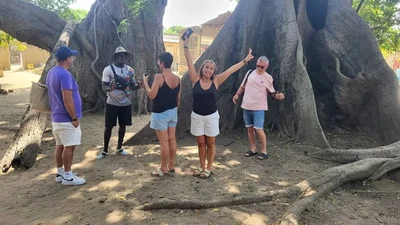
The carriage then leaves the village and enters a forest of baobabs. Among them, one stands out for its enormous size and the respect it commands: the sacred baobab of Nianing.
Why it is sacred
In traditional Serer society, griots held a special place. As keepers of memory, storytellers, and musicians, they transmitted the history of families and kingdoms. However, tradition did not allow them to be buried in the earth. Their bodies, wrapped in a shroud, were placed inside the hollow trunk of a baobab tree. Relatives would sometimes hang their musical instruments on it.
This practice ended around the time of independence, partly because President Léopold Sédar Senghor opposed it, in the name of the griots' dignity and public health risks. Since then, the baobab no longer holds graves, but it remains a revered site.
Entering the trunk
Its hollow trunk is so wide that you can enter it through an opening that looks like a door. Inside, the light filters through, the temperature drops, and you feel very small. Many visitors say it's the most powerful moment of the day. Demba will tell you its story and the beliefs surrounding it: even today, locals come here to reflect.
A Solidarity Gesture: The Cité de l'Emmanuel Nursery
A Solidarity Gesture
In Nianing, the Cité de l'Emmanuel nursery, run by the Sisters of the Holy Heart of Mary, welcomes and protects young children. If you wish to help, you can bring milk, diapers, or clothing: Demba will deliver them to the sisters with their consent. Out of respect for the children, no photos are taken.
This is not a tourist visit, and that's for the best. It's a simple stop, for those who wish, just long enough to drop off some useful donations. If you want to participate, check the corresponding box in the booking form: Demba will tell you what the sisters need most at the time of your visit.
How the Nianing Visit Works
Here is the usual itinerary for the half-day trip:
- Pick-up from your hotel (Saly, Somone, Mbour, Pointe Sarène).
- Arrival in Nianing and departure by horse-drawn carriage through the village.
- Visit to the Church of the Epiphany.
- Ride through the baobab forest to the sacred baobab.
- Stop at the nursery, if you wish.
- Return to your hotel.
All the details are on the Nianing by horse-drawn carriage page, and you can find more ideas on the Nianing destination page.
Combine With
Nianing pairs very well with other outings on the Petite Côte:
- Joal-Fadiouth, the shell island, about half an hour further south.
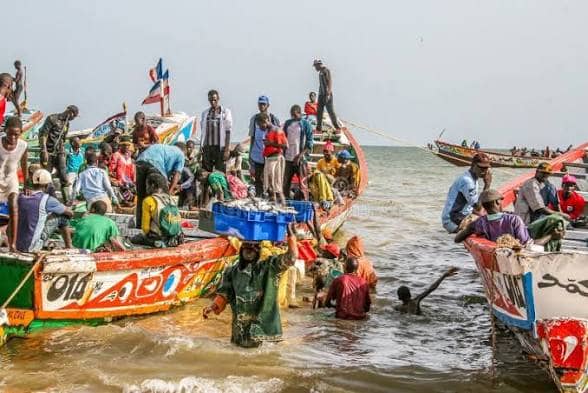
- The arrival of the fishermen in Mbour, in the late afternoon.
- The Senegalese day in the bush, to extend your encounter with the villages.
Frequently Asked Questions about Nianing
Do you have to be a believer to visit the church?
No. Everyone is welcome, as long as you respect the site and visit outside of mass times.
Can you enter the sacred baobab?
Yes, the hollow trunk can be visited. You should enter calmly and respectfully.
Is the tour suitable for children?
Yes, children love the horse-drawn carriage and the baobab. Just let us know their ages when booking.
Is the visit to the nursery mandatory?
No, it is completely optional. And out of respect for the children, no photos are taken there.
Nianing is Senegal at its gentlest: a horse moving at a walking pace, a surprising church, a tree that tells centuries of history. A half-day trip that will stay with you for a long time.
To Go Further
Our sources, and some useful reading to prepare for your visit:
Demba Sene, guide and driver on the Petite Côte since 2000. He speaks French, English and Spanish.